Accredited Qualsafe Qualifications

First Aid Training Courses

Meet requirements. Build confidence. Save lives.

50+ accredited courses
14 business awards
100s of 5-star reviews
UK-wide delivery
In short

First Aid training that protects your people and gives you confidence

Good first aid training helps you meet your legal responsibilities, gives your people the confidence to respond in an emergency and helps make sure the right support is available when it matters most.

We deliver nationally recognised Qualsafe First Aid qualifications, including Emergency First Aid at Work, First Aid at Work, Paediatric First Aid and Mental Health First Aid, together with refresher and requalification training.

Whether you need to train one person or coordinate first aid cover across multiple teams or sites, we’ll help you understand what level of provision you need, choose the right qualification and find the most practical delivery option for your business. Training is available at your premises anywhere in the UK, through public classroom courses, and by blended learning where appropriate.

Recognised qualifications, practical training and flexible options, so your first aiders know what to do, your business can demonstrate appropriate provision, and you can feel more confident that you’re prepared for an emergency.

A group of people engage in a First Aid Training in the Workplace session. In the center, someone demonstrates chest compressions on a mannequin, while a first aid kit sits nearby. Others attentively observe and take notes to enhance their lifesaving skills.
Find your course

Which first aid course do I need?

Not sure which course is right for you or your team? Use the guide below, or speak to our friendly team and we’ll help you choose the course that best fits the role, responsibilities and experience of the people being trained.

First Aid

If you are… Course Duration
If you are… Working in a lower risk workplace such as an office, shop or small business
Duration 1 day
If you are… Working in a higher risk workplace such as manufacturing, construction, hotels or warehousing
Duration 3 days
If you are… An existing first aider requalifying before your certificate expires
Duration 2 days
If you are… An existing first aider keeping your skills up to date
Duration ½ day
If you are… Working in childcare, early years or education
Duration 2 days
If you are… Needing combined adult and child first aid cover
Duration 1 day

Mental Health

Mental health first aid is just as important as physical first aid. It helps your team recognise the signs of common mental health conditions and know how to respond and signpost colleagues to further support.

If you are… Course Duration
If you are… Wanting to support workplace mental health awareness
Duration 1 day
If you are… Becoming a workplace Mental Health First Aider
Duration 2 days
If you are… Refreshing your Mental Health First Aid knowledge
Duration 1 day

Ready to book or need a hand choosing?

Get a free, no-obligation quote or talk it through with our friendly team.

Why it matters

Why first aid training matters for UK businesses

First aid training is about more than meeting a legal requirement. It gives people the confidence and practical skills to act quickly when someone is injured or suddenly becomes unwell.

Whether you run a hotel, warehouse, school, care home, factory or office, having the right people trained helps protect your employees, customers and visitors and gives you reassurance that someone knows what to do when it matters.

Under the Health and Safety (First Aid) Regulations 1981, employers must provide adequate and appropriate first aid equipment, facilities and personnel so employees can receive immediate attention if they are injured or taken ill at work.

You should also appoint someone to take charge of first aid arrangements and carry out a first aid needs assessment to decide what level of first aid provision is right for your workplace.

The right training helps you meet your legal responsibilities and gives you clear evidence that suitable first aid arrangements are in place.

What this means to you

The first step is understanding what level of first aid cover your workplace actually needs. A first aid needs assessment should consider things like your workplace hazards, number of employees, shift patterns, accident history, lone workers, remote locations and the needs of visitors.

From there, you can put the right equipment, facilities and trained people in place, giving you a practical first aid provision that fits the way your business operates.

Protecting your employees and the public

When something goes wrong, having someone nearby who knows what to do can make a real difference. First aid training gives your team the confidence to recognise an emergency and respond appropriately, whether that means carrying out CPR, using a defibrillator, controlling severe bleeding or helping someone who is choking.

Your first aiders also learn how to deal with common emergencies such as burns, fractures, shock and unconscious casualties, helping to protect employees, customers and visitors until professional medical help arrives.

Reducing the risk of serious harm

In an emergency, the first few minutes can really matter. Having someone nearby who knows how to respond can help prevent a situation from becoming more serious.  First aid training helps your team recognise when someone needs urgent help, stay calm under pressure and take appropriate action while professional medical support is on the way.

A confident, well-trained response can help reduce the impact of an injury or illness, support a quicker recovery and give everyone greater reassurance when an emergency happens.

Improving confidence and workplace culture

Good first aid training does more than teach practical skills, it helps people feel more confident about stepping forward when someone needs help. Regular training and refreshers can also strengthen hazard awareness, encourage better incident reporting and help first aiders keep their knowledge and confidence up to date.

The aim is to build a workplace where people feel prepared to act, rather than simply holding a certificate.

Protecting your reputation

How your business responds when something goes wrong can have a lasting impact on the people involved and on how your organisation is perceived.

Having trained first aiders in place helps you respond quickly and appropriately, demonstrates that you take your responsibilities seriously and gives employees, customers and visitors greater confidence in your arrangements.

Investing in first aid training shows that the safety and wellbeing of the people on your site really matters.

Further reading: HSE, First Aid at Work

Did you know?

Every year, tens of thousands of non-fatal workplace injuries are reported to the HSE under RIDDOR and the real number is likely to be higher. Having the right first aid arrangements in place helps make sure injuries and sudden illness are dealt with quickly, calmly and appropriately when they happen.

Legal reminder

There isn’t a set legal number of first aiders that every workplace must have. Instead, you need to carry out a first aid needs assessment and decide what adequate and appropriate provision looks like for your business, taking into account things like your workforce, hazards, working patterns and location.

Did you know?

Work-related injury and ill health cost Great Britain billions of pounds every year, with millions of working days lost as a result. Having the right first aid arrangements in place can help reduce the impact of an incident by making sure someone is ready to respond quickly and appropriately when it happens.

Envesca expert tip

Don’t just think about who your first aiders are — think about who is actually there when you need them. Holidays, sickness, shift patterns and people working across different sites can all leave unexpected gaps in first aid cover. A good first aid needs assessment looks beyond the number of certificates you hold and considers who will be available throughout the working day, and who provides cover when your usual first aider isn’t there.

Skills fade quickly

First aid confidence can drop if skills aren’t practised regularly. That’s why it’s worth keeping first aiders refreshed between formal requalification courses, particularly for practical skills such as CPR and emergency response. We recommend annual refresher training alongside the standard three-year requalification cycle, helping your first aiders stay confident, capable and ready to act when needed.

First aid fact

Immediate CPR and early defibrillation can make a critical difference in a cardiac emergency. This is especially important in health and social care settings, where residents, patients and service users may be more vulnerable to sudden cardiac or respiratory emergencies.

Envesca expert tip

Got a defibrillator? Make sure it’s ready — and make sure the ambulance service knows where it is.
Register your AED on The Circuit and keep its location and availability up to date, so it can be found quickly in an emergency. Don’t forget the practical checks too: defibrillator pads and batteries have expiry dates, so regular checks are important to make sure the equipment is ready when it’s needed.
Buying a defibrillator is only the first step — keeping it registered, checked and ready to use is what really matters.

FREE TOOL
Work out how many first aiders you need
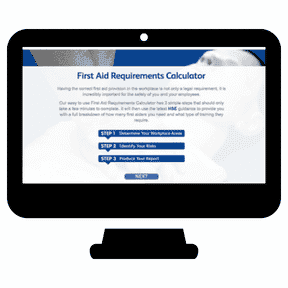
Qualsafe's free First Aid Requirements Calculator takes you through your workplace areas and the risks in each one. In a few easy steps you get a downloadable report that breaks down your first aid requirements and recommends the training your business needs.
first aid report

Opens on the Qualsafe Awards website. Not sure what your report is telling you?
Talk it through with our team.

Trusted for 30 years

Why choose Envesca?

We’re more than a course provider. We take the time to understand your business, give you clear, practical advice and help you stay compliant with confidence.

health and safety training

What Our Customers Say About Us

Browse courses

Our first aid training courses

Choose a course below to see full details, upcoming dates, duration, assessment information and the different ways you can learn. Whether you’re booking for one person or organising training for a whole team, we’ll help you find an option that works for your people, your business and your timescales.

We also offer non-accredited first aid training tailored to your business, so if you need something more specific to your workplace, processes or team, we can create training around what you actually need.

Need a hand choosing the right course?

Not sure which level is right for you or your team? Speak to our friendly team and we’ll help you choose the most suitable option.

Mental Health First Aid Refresher Training
Level 3
This one-day Mental Health First Aid Refresher course is designed for qualified Mental Health First Aiders who want to refresh their knowledge, rebuild confidence and keep their skills up to date.
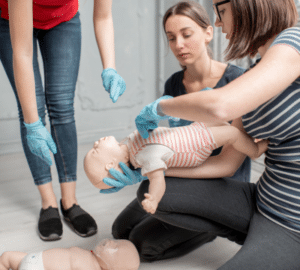
Three people wearing gloves are practicing combined emergency first aid by performing CPR on baby mannequins. One person holds a mannequin while others watch attentively. The mannequins, dressed in baby clothes, are carefully placed on the floor.
Level 3
This one-day Combined Emergency First Aid and Paediatric First Aid course gives you the practical skills and confidence to respond to emergencies involving both adults and children.
Mental Health First Aid Refresher Training
Level 3
This two-day Qualsafe course gives you the knowledge, practical skills and confidence to recognise when someone may be struggling, offer appropriate support and become a qualified Mental Health First Aider.
Two people are seated in an office setting, engaged in a conversation about understanding mental health. One is facing away, wearing a pink sweater, while the other, in a white blouse, faces the camera. Large windows in the background offer a blurred cityscape view.
Level 2
This one-day Qualsafe course helps you understand common mental health conditions, recognise when someone may be struggling and feel more confident listening, offering support and signposting them to appropriate professional help.
A person is lying on their side on the floor, supported by another individual wearing gloves, as part of a First Aid at Work Annual Refresher. Nearby, a third person kneels with gloved hands, ready to assist. The indoor scene underscores the importance of regular first aid training.
Level 3
This half-day First Aid at Work Annual Refresher course gives qualified first aiders the opportunity to refresh their knowledge, practise essential first aid skills and maintain confidence in responding to a workplace emergency.
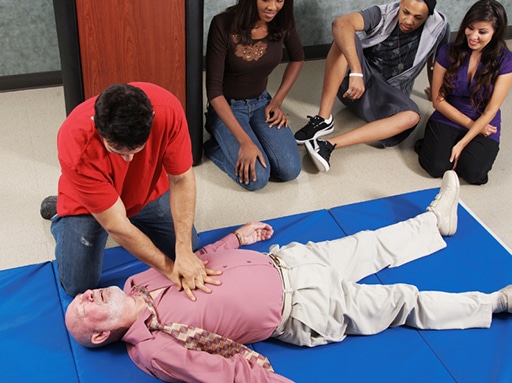
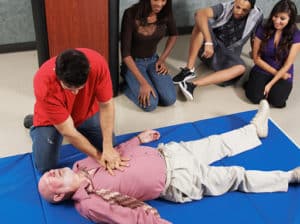
A man in a red shirt performs CPR on an older man lying on a blue mat, showcasing essential skills from an Emergency First Aid Course. Three onlookers are seated nearby, attentively watching the demonstration.
Level 3
A practical one-day Emergency First Aid at Work course that gives you the knowledge, skills and confidence to respond quickly and appropriately when someone is injured or taken ill at work.
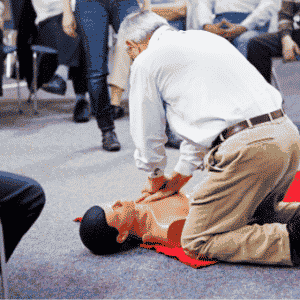
In the "Introduction to First Aid" eLearning session, an older man demonstrates CPR on a mannequin in a classroom setting, kneeling on a red mat while others are seated in a circle observing.
Level 3
A practical three-day First Aid at Work course that prepares you to respond confidently to a wide range of injuries, illnesses and workplace emergencies, with the skills to provide effective first aid until further help arrives.
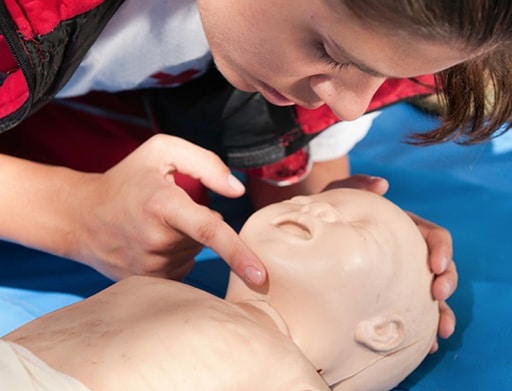
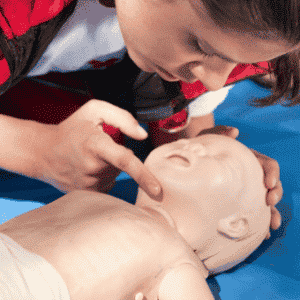
During the eLearning course for Level 3 Paediatric First Aid, a person practices CPR on an infant mannequin by pressing two fingers on its chest and tilting the head back while positioned on a blue mat. This scene highlights essential life-saving techniques.
Level 3
A practical two-day Paediatric First Aid course designed to meet EYFS requirements and give you the knowledge, skills and confidence to respond effectively to emergencies involving babies and children.
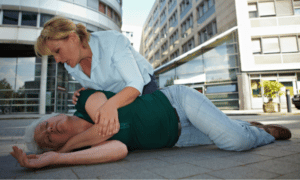
In a bustling city environment, a person in a light blue shirt tends to someone lying on the ground, wearing a green top and jeans. As they ensure their safety, it raises the question: do you have to have a trained first aider at work amidst such urban scenarios? Buildings loom in the background.
Level 3
This two-day Level 3 First Aid at Work Requalification course helps existing workplace first aiders refresh their knowledge, update their practical skills and renew their qualification so they can continue to respond confidently in an emergency.
However suits you

First aid training delivery options

Whether you’re training one person or coordinating training across multiple teams or sites, we’ll help you find the most practical option for your business. Choose from our public classroom or virtual courses, in-house classroom or virtual training exclusively for your organisation, or our online eLearning programmes, depending on what works best for your people, your operation and your timescales.

In-house classroom

Our expert trainers, many with emergency service backgrounds, deliver practical hands-on sessions at your premises anywhere in the UK, tailored to your workplace hazards and equipment.

Find out more →

Public classroom courses

Join a scheduled course at a local venue alongside delegates from other organisations. All practical skills are demonstrated and assessed face-to-face, leading to a recognised Qualsafe qualification.

Find out more →

Blended learning

Complete the underpinning theory online, then attend a shorter practical assessment day. Less time away from work, with the hands-on assessment still fully covered.

Browse blended learning →

Refresher and requalification

Keep skills and certification current with annual refresher courses and First Aid at Work requalification, so you avoid a lapse in cover and the cost of repeating a full initial course.

View refresher courses →

Need help choosing?

Our team will help you complete a first aid needs assessment and recommend the most suitable, cost-effective option based on your workplace risks, employee numbers and locations.

Request a quote →
Tailored to your world

First aid training for your industry

First aid needs are different in business. The risks, responsibilities and day-to-day challenges in a warehouse, care home, hotel, school or food factory are not the same. That’s why we tailor our training to your industry and the way your business actually operates, helping your team understand what good food safety looks like in their own workplace.

A waiter exemplifies hospitality as he serves pizza and salad to a casually dressed couple at a restaurant. They smile, holding glasses of red wine amidst the cozy ambiance created by wooden chairs and stone walls.

Hospitality, leisure and tourism

From hotels and restaurants to pubs, cafés, golf clubs and holiday parks, busy customer-facing environments need first aid cover that works around staff, guests, events and changing levels of activity.

We provide practical Emergency First Aid at Work and First Aid at Work training, alongside Mental Health First Aid and Paediatric First Aid, helping you make sure the right people are trained and ready to respond when something happens.

Level 4 Food Safety Certification

Food and drink manufacturing

Busy manufacturing sites can involve machinery, manual handling, chemicals, vehicle movements and shift work, so first aid cover needs to reflect the real risks of the operation.

We support manufacturers with First Aid at Work training, first aid needs assessments, defibrillator awareness and practical consultancy, helping you make sure the right people are trained, available and ready to respond across shifts and departments.

Students in the school classroom raise their hands while seated at desks. A teacher stands at the front near a whiteboard, engaging with the class. The room is brightly lit, and various educational materials are visible on the walls.

Schools, colleges and nurseries

In education and childcare settings, first aid arrangements need to protect both staff and the children and young people in your care.

Early years providers also need to meet the EYFS requirements for paediatric first aid cover. We provide Paediatric First Aid, Emergency First Aid at Work, Combined Emergency First Aid and Paediatric First Aid and Mental Health First Aid training for teaching, catering and support teams, helping you make sure the right people are trained and confident to respond.

A caregiver in green scrubs assists an elderly man with a walker, as the scent of warm meals wafts through the air from a nearby food and drink manufacturing display. In the background, another caregiver in blue helps an elderly woman seated with a walker in the well-lit room.

Health, nursing and social care

In care and healthcare settings, first aid needs can be more complex because residents, patients and service users may be more vulnerable or have existing health conditions.

We provide practical First Aid at Work, Emergency First Aid at Work and Mental Health First Aid training, helping staff feel confident to respond appropriately and support the people in their care when something goes wrong.

Good to know

First aid training: your questions answered

Not sure which course you need, how the training works or what your responsibilities are? These are some of the questions we’re asked most often when people are choosing first aid training. For more detailed guidance on legal requirements, training records, take a look at our Training FAQs and Knowledge Centre.

Your legal duties

Is first aid training a legal requirement in the UK?

Yes. The Health and Safety (First Aid) Regulations 1981 require every employer to provide adequate and appropriate equipment, facilities and personnel so employees receive immediate attention if they are injured or become ill at work. This applies to all workplaces regardless of size, and to the self-employed.

You must carry out a first aid needs assessment to determine the right level of provision, which may range from an appointed person in a low-risk office to several qualified first aiders in a higher-risk environment. Failure to comply can result in enforcement action, fines or prosecution.

Every workplace needs at least one person, either a trained first aider or an appointed person, responsible for first aid arrangements. This applies even if you are self-employed or have a single member of staff.

The number of first aiders required depends on your first aid needs assessment, which considers the nature of your work, employee numbers, workplace hazards, shift patterns and accident history. Higher-risk workplaces such as manufacturing sites, warehouses and construction sites typically need a higher ratio of trained first aiders than low-risk offices.

A first aid needs assessment reviews your workplace to determine the type and level of provision you need. It should consider the nature of your work, workplace hazards, employee numbers, shift patterns, accident history, distance to the nearest emergency medical services, and the needs of lone workers, remote sites and visitors.

The assessment determines how many first aiders or appointed persons you need, which qualification is appropriate, what equipment and facilities you must provide, and whether a defibrillator is advisable.

Yes. Under the Early Years Foundation Stage statutory framework, registered early years providers must ensure at least one person with a current full paediatric first aid certificate is always on the premises and available when children are present, and that specific staff ratios hold full paediatric first aid training.

This is a separate legal requirement from the general workplace duties under the 1981 Regulations.

Choosing and attending a course

What first aid training do I need?

The right level depends on your first aid needs assessment. As a guide, Emergency First Aid at Work suits lower-risk workplaces such as offices, shops and small businesses, while First Aid at Work is designed for higher-risk environments such as manufacturing, construction and warehousing.

Additional or specialist training such as Paediatric First Aid or Mental Health First Aid may also be needed depending on your sector and workforce.

Emergency First Aid at Work is a one-day course covering core emergency skills such as CPR, choking, bleeding control and the recovery position, and suits lower-risk workplaces.

First Aid at Work is a three-day course covering everything in the one-day course plus conditions such as fractures, burns and illnesses including diabetes, asthma and seizures. It is designed for higher-risk workplaces, or where your needs assessment identifies a need for more comprehensive training.

Course length depends on the qualification. As a guide, Emergency First Aid at Work is one day, First Aid at Work is three days, the requalification is two days and the annual refresher is a half-day. Paediatric First Aid is typically two days.

Yes. Onsite training is a practical, cost-effective way to train your team. It reduces travel time and lets the trainer use scenarios and equipment relevant to your workplace and its specific hazards.

The practical skills in accredited qualifications, such as CPR and choking response, must be assessed face-to-face, so a fully online accredited first aid qualification is not possible. Underpinning theory can be completed online in a blended format ahead of a shorter practical session.

Non-accredited awareness eLearning is available for topics such as basic emergency first aid awareness, mental health awareness and specific hazard training.

Mental Health First Aid gives employees the knowledge and confidence to recognise the signs of common mental health conditions such as stress, anxiety and depression, and to support colleagues appropriately, including signposting to further help.

It is not a specific legal requirement in the way physical first aid is, but it supports your duty under the Management of Health and Safety at Work Regulations 1999 to assess and manage work-related stress and mental health risks.

Certificates, records and renewals

How long does a First Aid at Work certificate last?

First Aid at Work, Emergency First Aid at Work and Paediatric First Aid certificates are all valid for three years from the date of the course. You must ensure a requalification course is completed before the certificate expires to avoid a lapse in cover.

If a certificate expires before requalification training is completed, the holder is no longer considered a qualified first aider and must retake the full course rather than the shorter requalification.

To avoid this, most employers schedule requalification training a few weeks before the expiry date.

Ready to book or need a hand choosing?

Get a free, no-obligation quote or talk it through with our friendly team.

Before you go, why not use our handy First Aid Needs Analysis Calculator to help assess your business needs?

In a few easy steps you'll have a downloadable report that breaks down your first aid requirements and will recommend the training needed for your specific business.